
The Problem with Centralized Infrastructure
Public cloud solved many problems of scale and accessibility, but created others, some silent and others structural.
Organizations that operate with sensitive data (health, legal, financial) or require full operational control face three concrete risks: unpredictable latency, recurring costs that scale without warning, and growing regulatory risk (GDPR, digital sovereignty, data localization).
Public cloud is not the problem. The problem is exclusive dependence on it, especially when technical alternatives exist that offer control, predictability, and compliance without sacrificing performance.
The alternative is edge computing with compact professional hardware. It is not a fad. It is a strategic decision that places critical infrastructure where it must be: under direct operator control.
The Common Mistake: Confusing a “Mini PC” with an “Edge Workstation”
Many decision-makers see a compact chassis and assume it is just a “glorified mini PC”. This mistake is expensive.
A Mac Mini or an Intel NUC are excellent for office work, individual development, or media centers. But they were not designed for continuous workloads, high-speed network aggregation, or environments where memory corruption can stop an operation.
What a consumer system lacks:
- ECC (Error-Correcting Code) memory: in 24/7 workloads, the chance of bit flips increases. ECC detects and corrects errors before they corrupt data or crash processes.
- Dense, professional network I/O: 2.5 GbE is enough for office use, but not for IoT traffic aggregation, storage replication between sites, or segmentation of critical networks.
- High-speed expansion connectivity: generic USB-C does not replace USB4 v2 at 80 Gbps when you need to connect external NVMe arrays or PCIe accelerators.
When an NUC is not enough, the traditional answer was “buy a rack server”. But that implies physical space, dedicated cooling, noise, and power consumption that is disproportionate for many SMEs.
This is where enterprise-class compact workstations change the game.
MINISFORUM MS-02 Ultra: Specifications That Matter
MINISFORUM has been consolidating its position in the compact professional hardware segment. The MS-02 Ultra, planned for distribution in Portugal in early 2026, sits above traditional mini PCs and competes directly with tower workstations in capacity, but in a footprint of 22 x 10 cm and 3.45 kg.
Processor and Memory
- Intel Core Ultra 9 285HX: a mobile-class CPU adapted for continuous operation, with configurable TDP and support for parallel workloads.
- Up to 192 GB ECC DDR5 SO-DIMM (4 slots): error-correcting memory, essential for dense virtualization, critical databases, and local AI inference.
Network Connectivity
This is the main differentiator:
- 2x 25 GbE SFP+ ports: aggregation, redundancy, or segmentation of high-speed networks (storage, production, management).
- 1x 10 GbE RJ45 port: connection to core switches or uplink to hybrid cloud.
- 1x 2.5 GbE RJ45 port: out-of-band management or isolated admin network.
- Wi-Fi 7 + Bluetooth 5.4: latest-generation wireless connectivity for hybrid scenarios.
Expansion and Storage
- 2x USB4 v2 (80 Gbps) + 1x USB4 (40 Gbps): connect external NVMe storage, eGPUs, or professional docks without bottlenecks.
- 4x M.2 2280 slots (mix of PCIe 4.0 and 3.0): two slots integrated on the 25 GbE network board, enabling RAID or distributed storage configurations without external bays.
Power and Chassis
- 350 W internal PSU: no external power brick, reducing points of failure and simplifying cable management.
- Dimensions: 22 cm x 10 cm x 22 cm (D x W x H), compatible with compact racks or under-desk/wall installations.
MINISFORUM will offer three SKUs: barebone (for integrators), 96 GB ECC + 2 TB SSD, and 192 GB ECC + 2 TB SSD, all with Windows 11 Pro pre-installed (except barebone).
Real Use Cases in Intuitive Code Projects
Intuitive Code uses MINISFORUM systems (notably the N5 Pro AI NAS) in real implementations, for both enterprise clients and individual professionals based in Portugal who require data sovereignty and predictable performance.
Internally, Intuitive Code also operates on this category of hardware.
1. High-Throughput Private NAS
Context: organizations that depend on file sharing (dozens of GB per day), incremental backup, and synchronization between offices, but want to eliminate Dropbox, Google Drive, or equivalents.
Implementation: N5 Pro as primary storage, with automatic replication via rsync or Syncthing to a second remote node. Access via SMB/NFS for internal teams, WireGuard VPN for external access.
Result: local latency (<1 ms), predictable costs (one-time CAPEX), GDPR compliance guaranteed (data never leaves the EU).
2. Edge Compute for Industrial Automation
Context: factories or logistics operations that aggregate data from IoT sensors (temperature, vibration, counters) and need local processing to react in real time.
Implementation: MINISFORUM as an edge node running Proxmox, with isolated VMs for aggregation (InfluxDB), visualization (Grafana), and AI inference (anomaly detection via local models).
Result: decisions in milliseconds (no cloud dependency), elimination of egress costs, resilient operations even with WAN connectivity loss.
3. Hybrid Infrastructure for Consultants and Law Firms
Context: offices that handle sensitive documents (contracts, legal cases, audits) and cannot rely on generic SaaS.
Implementation: N5 Pro as an encrypted file server (LUKS), combined with NextCloud for controlled sync and automatic backups to external storage.
Result: full auditability (local logs), zero dependence on third parties, fixed costs.
4. Laboratories and Development Environments
Context: technical teams that need to test multiple environments (Kubernetes, databases, APIs) without paying for cloud staging.
Implementation: 96 GB ECC allows 10-15 VMs to run simultaneously (Proxmox, VMware ESXi), with fast snapshots and instant rollback.
Result: shorter development cycles, zero compute costs, full isolation between projects.
5. WAN Redundancy with Starlink + Fiber
Context: critical operations that cannot stop (clinics, remote offices, industrial operations).
Implementation: MS-02 Ultra (or N5 Pro) as gateway/firewall (pfSense/OPNsense) with two WANs: primary fiber + Starlink as failover. Configurable load balancing or active-standby.
Result: uptime > 99.9%, controlled latency, independence from a single ISP.
Where the MS-02 Ultra Changes the Game (vs. N5 Pro)
The N5 Pro AI NAS is a solid system, but the MS-02 Ultra expands the possibilities in three critical axes:
1. More Memory (192 GB vs. 96 GB)
Enables:
- Dense virtualization: 20-30 VMs simultaneously with real workloads (databases, APIs, test environments).
- Aggressive caching: distributed storage systems (Ceph, MinIO) benefit directly from more RAM for metadata and read operations.
- Local AI inference: large language models (LLMs) with 30-70B parameters can run locally via Ollama or vLLM, removing dependence on external APIs.
2. More Network I/O (Dual 25 GbE SFP+)
Enables:
- Traffic aggregation: multiple clients or IoT sensors streaming data simultaneously without saturating the network.
- Fast replication between sites: sync terabytes between offices in minutes, not hours.
- Segmentation of critical networks: production, management, and backup on isolated VLANs, each with dedicated bandwidth.
3. More NVMe Slots (4 vs. 2)
Enables:
- Local RAID for performance: RAID 10 with 4x NVMe delivers >10 GB/s throughput with redundancy.
- Storage tiers: fast NVMe for active workloads, SATA for cold archives (via USB4 or network).
- Distributed storage nodes: each MS-02 Ultra can function as a brick in a Ceph or GlusterFS cluster.
4. New Operational Capabilities
The MS-02 Ultra can operate as:
- Compact hypervisor (Proxmox, ESXi): replacing rack servers in small installations.
- Distributed storage node (Ceph, MinIO): part of a resilient object storage infrastructure.
- High-speed firewall (pfSense, OPNsense): with deep packet inspection at 10-25 Gbps.
- Edge AI inference node (Ollama, vLLM, local LLMs): natural language processing without sending data to the cloud.
Reference Architecture: MS-02 Ultra as an Edge Node
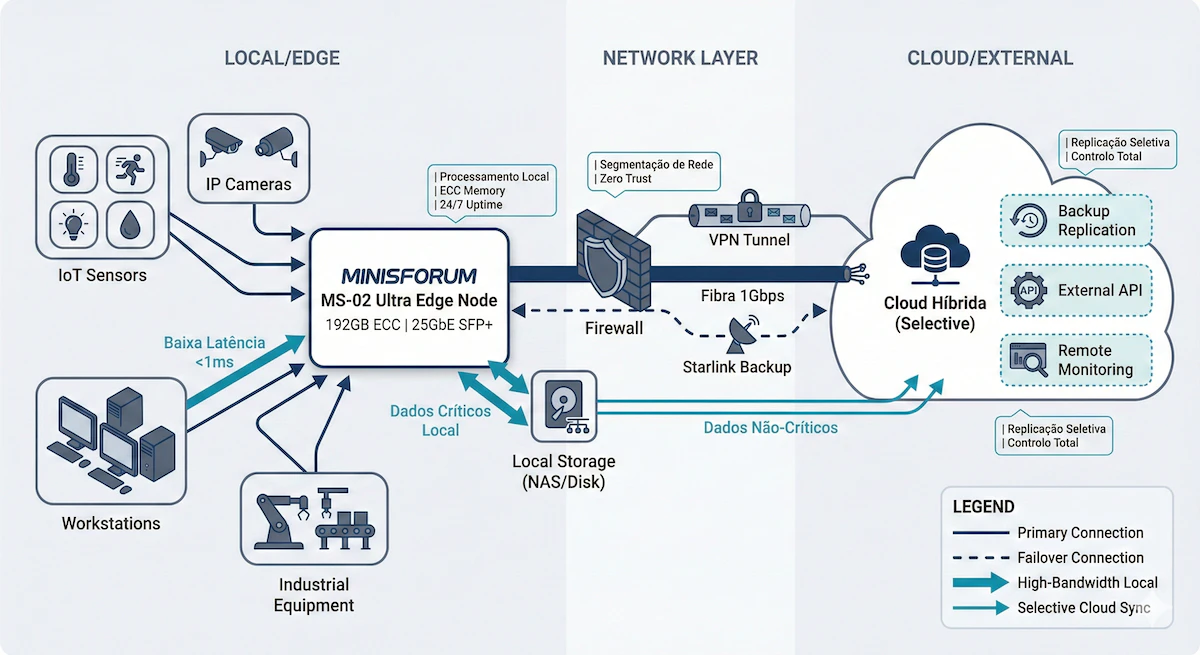
Typical configuration: the MS-02 Ultra works as an edge node that aggregates local devices (IoT, workstations, cameras, industrial equipment), processes critical data locally with <1 ms latency, and synchronizes selectively with hybrid cloud only for non-critical data. WAN redundancy via primary fiber + Starlink ensures operational continuity.
Operational Impact: What Changes in Practice
The specifications matter, but what matters to decision-makers are observable results.
Latency Reduction
Locally processed data responds in milliseconds, not hundreds of ms (public cloud). For industrial automation or critical applications, this is the difference between reacting in time and missing the window of action.
Elimination of Recurring Costs
Public cloud charges for compute, storage, egress, and IOPS. An MS-02 Ultra is one-time CAPEX: after purchase, costs are limited to electricity (< EUR 10 per month) and occasional maintenance.
For an SME spending EUR 500-1000 per month on cloud, ROI happens between 12-18 months.
Regulatory Compliance
Sensitive data (health, legal, financial) never leaves Portugal or the EU. This eliminates GDPR audit risk, simplifies compliance, and reduces exposure to unpredictable regulatory changes (e.g., Digital Markets Act, Data Act).
Full Lifecycle Control
Updates, patches, and retention policies are decided internally, not imposed by a SaaS vendor. This is critical for organizations in regulated sectors or those that cannot tolerate unplanned downtime.
Strategic Decision: When It Makes Sense
The MS-02 Ultra is not for everyone. It is a technical solution for specific contexts where control, sovereignty, and predictable performance are priorities.
It makes sense for:
Organizations with Sensitive Data
- Healthcare: clinical records, imaging, patient data that cannot leave controlled premises.
- Legal: cases, contracts, audits that require full auditability and guaranteed confidentiality.
- Financial: customer data, transactions, risk analysis that cannot depend on third parties.
Industrial Operations with Uptime Requirements
- Continuous production: where 1 hour of downtime costs tens of thousands of euros.
- Critical logistics: where real-time decisions (routing, inventory, dispatch) directly impact revenue.
Technical Teams that Need Dense Environments
- Development and QA: multiple isolated environments, integration tests, local CI/CD.
- Research and labs: simulations, data analysis, model training without paying for cloud.
Expatriates and Professionals Seeking Personal Sovereignty
- Independent consultants: who handle client data and cannot rely on generic SaaS.
- Content creators: who produce terabytes of video/photography and want fast local backup without cloud.
In these contexts, hardware selection stops being a technical decision and becomes a strategic decision for operational sovereignty.
MINISFORUM in Portugal: Intuitive Code Partnership
Intuitive Code is in advanced talks with MINISFORUM to become an official partner in Portugal, expanding the ability to implement solutions based on compact professional hardware.
We have already implemented multiple projects based on the N5 Pro AI NAS, for both companies and individual professionals based in Portugal. The MS-02 Ultra represents the next generation of this approach: more memory, more I/O, more operational capabilities, while keeping the compact footprint.
If you operate an organization where data control, predictable latency, and independence from public cloud are priorities, this category of hardware can change how you think about infrastructure.
Next Steps
Use cases: explore real implementations of private NAS, edge compute, and WAN redundancy in use cases.
Process: see how we audit, design, and implement critical infrastructure in process.
Contact: to discuss whether the MS-02 Ultra (or N5 Pro) fits your context, talk to us.
Technical note: pricing and availability of the MS-02 Ultra in Portugal will be confirmed in January 2026. For immediate projects, the N5 Pro AI NAS remains available and already implemented in multiple operational contexts.